
CoWordle: Rules How to Play New Puzzle and Win Every Step

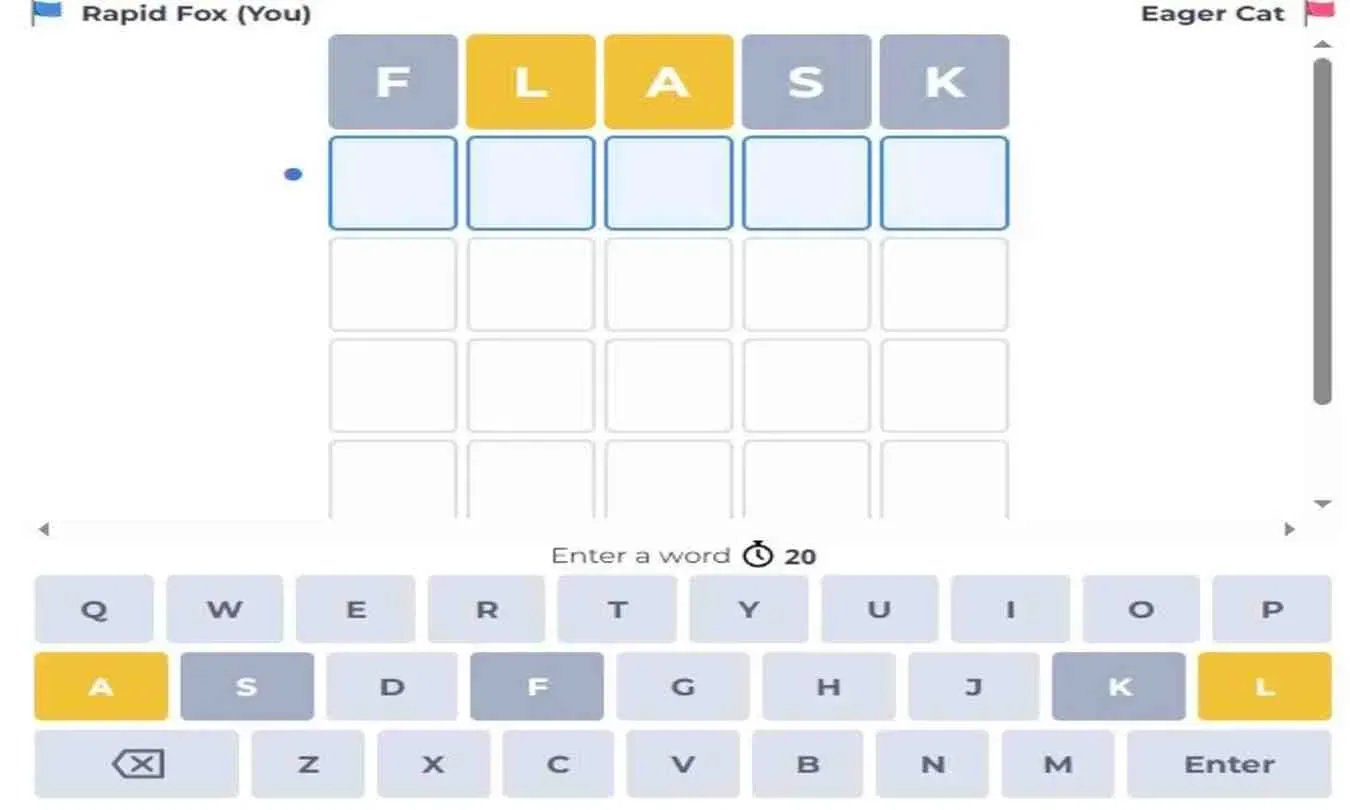
Word puzzle players are always excited to reveal new challenges. CoWordle is one of the most famous game of puzzle to the fans where has challenges in every battle. It offers the opponent the chance to guess the same hidden word first. It is so competitive, with time pressures and rewards of quick thinking. People who love puzzles nowadays are getting addicted to this for the enjoyment related to others wordle puzzle. Here, you may get how to play and basic knowledge about it.
What Is CoWordle?
CoWordle is a multiplayer twist 5×6 leaderboard on the classic Wordle format. You can select a random opponent or invite your friend, and both players try to guess the same secret five-letter word at the same time. The main mechanics stay familiar. There are 3 colourful letters (yellow, green, and grey/white) on the board after each attempt. The green tiles mean a correct letter in the correct spot, yellow means the letter exists but is in the wrong position, and grey/white means it isn't in the word at all. A real live game, where pressure increases faster as time goes.
How to Play CoWordle Step by Step Explained
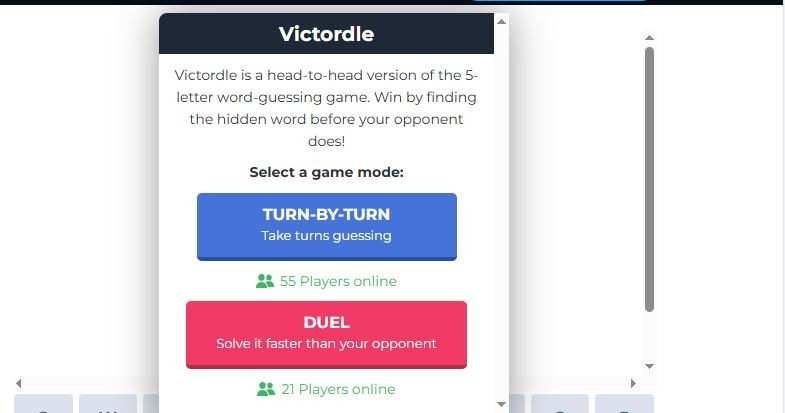
1. Pick your match type. At first, install the game app or play on the web. Set up all settings and tap:
1. Turn BY Turn – Within 30 seconds only to guess the word and put that on board
2. DUEL – It needs 60 seconds to put up the word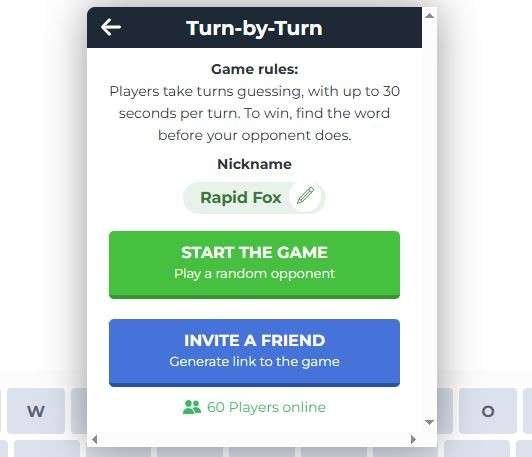
Both buttons have random gameplay and an invite link specifically. Press anyone where you want to join. If you're playing with a friend, send the link before you open the board. Open fast; otherwise a session will close before entry and the link won’t work to join.
2. Confirm both boards are synced. Waiting for your opponent. If it needs more than 15–20 seconds.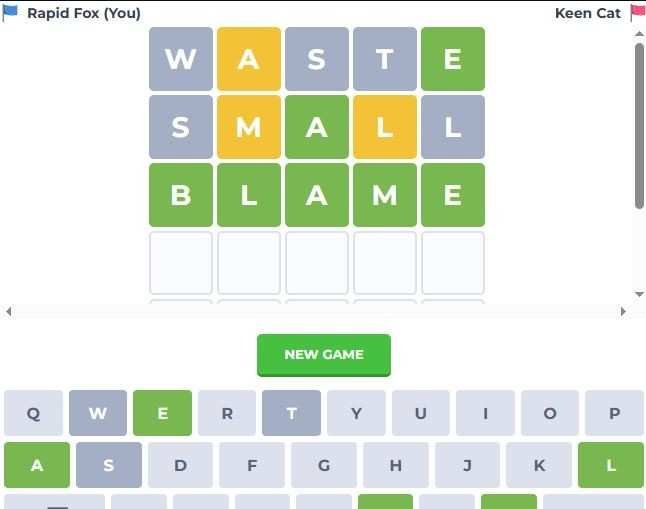
Color Rule Indicator:
Green tiles → Correct letter, correct position
Yellow tiles → Correct letter, wrong position
Grey tiles → Letter not in the word
3. Submit your first guess carefully. The input only accepts real dictionary words. If your guess gets rejected, you will lose the game. The correction mainly depends on 3 things: 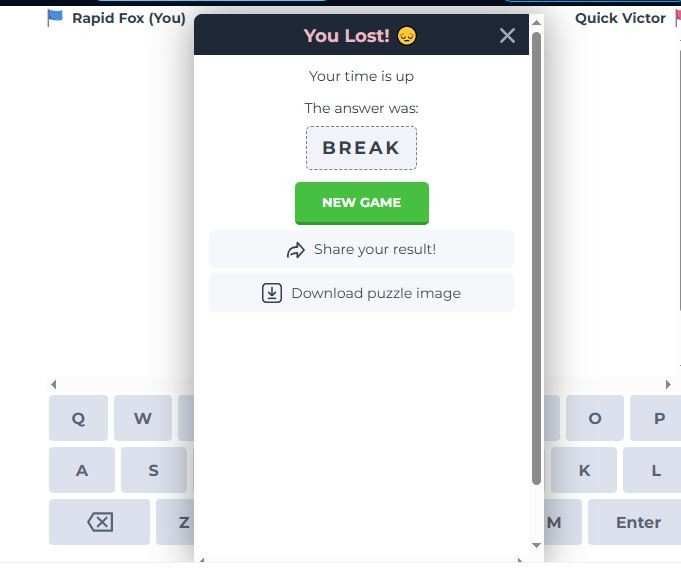
→ misspelling,
→ word shorter/longer than five letters,
→ word not in the game's accepted word list (Don’t apply any slang/negative words).
4. Read tile feedback before typing your next guess. A common mistake is typing the next guess too fast under time pressure and accidentally reusing a grey (eliminated) letter. Before input, just set in mind all five tiles first.
5. Watch the timer, not just the board. Each guess has its own countdown. If you run out of time mid-guess, an incomplete entry is automatically discarded — it does not count as a used attempt, but it does cost you the time, so finish typing before refining your logic.
6. Track your opponent's progress indicator. Most versions show a small marker for how many guesses your opponent has used, without revealing their letters. If they're closing in faster than you, prioritise speed over a "perfect" guess.
7. End of round. The moment either player solves it, the round locks immediately for both boards. If you solve it but the screen doesn't confirm a win, refresh — this is a display lag issue, not a scoring error.
CoWordle Rules for Every Win
Word length is fixed at five letters- You must try to find within this letters.
The accepted word list is dictionary-based- Give always valid words but unusual words (like CRYPT or VIXEN) will be accepted even if you wouldn't guess them as a target word.
Six attempts per round is standard, but quick-play or "blitz" modes may reduce this. Always check the mode label before assuming the attempt count.
The timer resets per guess, it does not carry over unused time from a previous guess to next. Saving time early does not give you a longer window later.
Letter repetition is scored individually per tile, meaning if a word has two of the same letter and you guess it once, only the matching tile(s) turn green/yellow — the system does not "remember" the duplicate for you.
Ties are decided by a draw, not a replay of the same word. If both players run out of attempts, the round ends as a draw and a brand-new word is generated for the rematch — the original word is never reused.
Disconnection forfeits the round in most versions. If you lose connection mid-round, reconnecting typically returns you to the lobby rather than the same match, so save guesses you're confident about quickly rather than stalling.
There is no penalty for an incorrect guess beyond losing one attempt — incorrect guesses don't add time penalties on top.
Tips and Tricks to Win Every Game
- Start with vowel-rich words like ADIEU or AUDIO to identify vowels quickly.
- Avoid repeating letters in early guesses to test as many letters as possible.
- Think in patterns, not single guesses, narrowing positions after every attempt.
- Never reuse a grey letter, since you already know it isn't in the word.
- Stay calm under the timer, as most mistakes come from excitement.
- Use common combinations like "ST," "TR," "ER," and "IN," which appear often in five-letter words.
Characteristics of CoWordle
- Real-time synchronous play — both boards update live; this is the core feature that separates it from solo Wordle clones.
- Identical hidden word for both players — fairness is built into the format itself, so outcomes are skill-based, not luck-based.
- Per-guess timer — unlike Wordle's unlimited daily thinking time, CoWordle forces decision-making under a clock.
- Unlimited replay — no daily puzzle restriction; you can play as many rounds back-to-back as you want.
- No account or download required — runs directly in-browser on both desktop and mobile, which keeps friction low for casual play.
- Color-coded feedback system — green/yellow/grey, identical logic to Wordle, so there's no learning curve for existing fans.
- Two match formats — random matchmaking for quick games, or private invite links for playing specifically against friends.
- Draw-resolution built in — the game is designed to never leave a round unresolved; it always ends in a win or a clearly defined draw.
Are There Any Health Benefits to Playing?
Yes, casual word games like CoWordle offer more than entertainment. Regular play can:
Sharpen vocabulary and spelling.
Improve cognitive speed.
Support memory and focus.
Reduce stress in short bursts.
But never do any work positive or beneficial, whatever it is, because too much screening time may lead to addiction and will get many health problems like headache, spasms, lethargy, weakness, etc.
10 Alternative Games Like CoWordle
- Wordle – The original daily word-guessing game.
- Quordle – Solve four Wordle puzzles at once.
- Dordle – A two-board version of Wordle.
- Octordle – An eight-board challenge for advanced players.
- Heardle – Guess the song from a short audio clip.
- Worldle – Identify countries from their outline.
- Nerdle – A number puzzle using math equations.
- Waffle – Rearrange letters across a grid to form words.
- Framed – Guess the movie from film stills.
- Squabble – Another fast, competitive Wordle-style game.
Frequently Asked Questions
1. Is CoWordle free to play?
Yes, it's completely free and playable directly in your browser.
2. Can I play CoWordle on mobile?
Yes, it works on both desktop and mobile browsers.
3. Does CoWordle have a daily puzzle like Wordle?
No, it allows unlimited rounds with new opponents, unlike Wordle's single daily puzzle.
4. Can I play with a stranger or only friends?
Both options exist, you can be randomly matched or invite a specific friend.
5. What happens if no one guesses the word in time?
The round ends in a draw, and a rematch can start immediately.
Final Thoughts
CoWordle takes everything people love about Wordle and adds real-time competition that makes every round exciting. By learning the rules, following a clear step-by-step approach, and applying smart strategies, you can consistently outpace opponents and win more often. Whether you're a Wordle veteran or new to word puzzles, CoWordle is easy to pick up and hard to put down, making it a great daily addition to your puzzle-solving routine.

In the United States, gambling is supposed to be tightly regulated, fragmented state-by-state, and controlled by a framework rooted in the old casino capitals — Las Vegas and Atlantic City. Yet a quiet shift is underway. Across 2024–26, gambling has become less a location you visit and more an activity that follows people wherever the law allows it to exist.
And that law is stretching further every year.
From prohibition map to patchwork market
Six years ago, only a handful of states allowed legal sports betting. Today, more than 38 states and Washington D.C. in some form permit it — a transformation triggered by the Supreme Court’s 2018 decision overturning PASPA.
That ruling didn’t just open the door; it blew the hinges off.
States began to calculate the math themselves:
legal market + tax revenue + economic activity > prohibition.
The result: America is quietly building the largest regulated betting market on Earth, but without a single national rulebook or central regulator.
Where the money is actually going
U.S. sportsbooks reported over $120 billion in handle in 2023 — the amount wagered — and analysts expect that figure to cross $150 billion by 2026 if current trends hold.
But the numbers that should matter most aren’t the wagers; they’re the losses.
American bettors lost roughly $10–11 billion on sports bets in 2023 alone.
That’s not counting online casino play — legal in only seven states, yet already approaching $6–7 billion in annual operator revenue.
These numbers rarely make headlines. The public hears about tax wins, jobs, and Super Bowl betting frenzies, not the cumulative effect of tens of millions of micro-bets disappearing from debit cards every weekend.
The digital casino that never clocks out
One thing that separates the U.S. gambling boom from previous eras is accessibility.
Where Las Vegas once required a plane ticket, today gamblers need only a smartphone and a Wi-Fi signal.
Casino-style games — slots, blackjack, roulette — remain technically illegal online in most states. But regulators are discovering that “lines on paper” mean little to consumers who understand how to use VPNs, offshore domains, or social “sweepstakes” models.
That’s why, in online discussion threads, you’ll occasionally see references to non gamstop casinos or commentary about casinos not on gamstop, even though GamStop is a UK system. It’s shorthand for offshore platforms that operate outside U.S. law — a reminder that the digital border is far more porous than lawmakers imagined.
And while U.S. regulators stress legal options, player chatter often pushes toward whatever feels easiest or most entertaining, including casual mentions of the best non gamstop casino alternatives for those who don’t care where a website is licensed.
Who pays the cost
Industry lobbyists argue that legalisation reduces harm by replacing unregulated markets. There’s truth there: regulated sportsbooks pay taxes, offer customer records, and can be compelled to freeze accounts or block suspicious activity.
But states don’t yet collect consistent data on addiction rates.
Only seven states fund problem-gambling programs at levels public-health advocates deem adequate.
Some states that earn hundreds of millions in wagering taxes invest less than $1 million into treatment.
The absence of federal oversight means everyone measures “risk” differently.
One state bars credit cards for deposits; the next doesn’t.
One blocks celebrities on ads; another runs billboards outside universities.
Between the lines, a picture forms: the system isn’t designed — it’s evolving in real time.
What comes next
Analysts believe the U.S. market will continue expanding until:
1. Nearly every state legalises sports betting, and
2. A majority legalise or semi-legalise online casino play.
That second stage worries public-health groups most. Casino games, unlike sports betting, don’t require knowledge, research, or pre-existing fandom. They move faster, trigger dopamine quicker, and statistically create more losses over time.
If sports betting was the “gateway” step, online casinos are the real policy battleground ahead.
The unanswered question
America is building a new national pastime — without ever officially declaring it.
The real investigative question isn’t whether gambling will spread.
The numbers show that’s already settled.
It’s who will benefit and who will absorb the losses:
• State governments hungry for tax revenue?
• Massive private operators and their few parent companies?
• Or bettors themselves, who currently subsidise both?
With no federal standard, the U.S. is testing a vast social experiment in live mode.
Millions are participating. Billions are moving.
And the rules remain largely unwritten.
-
 Gaming11 months ago
Today Wordle Hint Puzzle Game Solve
-
 Gaming11 months ago
Connections Hint Today Mashable Winning Puzzle Daily
-
 Gaming8 months ago
Octordle Hint: The Ultimate AI-Powered Guide to Winning the Game Smartly
-
 Gaming8 months ago
Toy Theater: The Ultimate Online Playground for Learning, Creativity, and Fun
-
 Gaming8 months ago
Strands Hint Today – Simple Clues Before the Answers
-
 Gaming7 months ago
Cowordle: The Ultimate Guide to the Multiplayer Word Puzzle Game